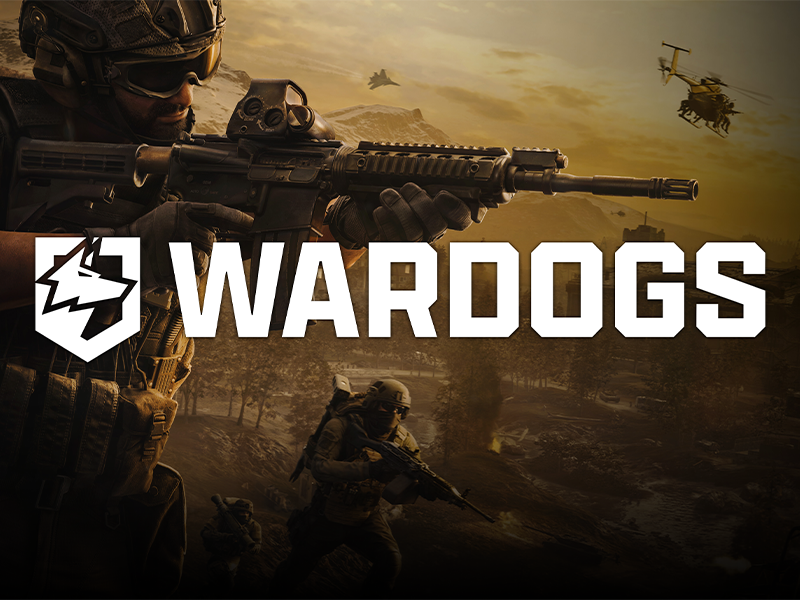
Prepared for RUIN Gaming Community LeadershipDate: 16 September 2026 Deep Dive Report & Preliminary Support Assessment for RUIN Gaming Strategic Evaluation of a Large-Scale Tactical FPS, Community Fit, Organizational Opportunity, and Recommended RUIN Support Model. WARDOGS represents a high-potential addition to RUIN Gaming’s multi-game portfolio because its fundamental design philosophy aligns unusually well with the multiplayer experiences the organization has historically sought to cultivate. The game emphasizes organized teamwork, meaningful specialization, sustained communication, leadership development, logistics, and the formation of persistent relationships between players rather than isolated short-session matches.
Developed by Bulkhead and published by Team17, WARDOGS entered Steam Early Access on 10 September 2026 following closed beta testing in late August and quickly demonstrated substantial commercial and community traction. The title places up to one hundred players into three competing mercenary factions that contest a randomized Control Zone inside expansive maps measuring approximately two hundred fifty-six square kilometers. Unlike the battle-royale or extraction-shooter models that currently dominate much of the multiplayer market, WARDOGS prioritizes territorial control, combined-arms warfare, player-driven logistics, construction, tactical positioning, and sustained faction-level conflict. Its most strategically relevant feature is the persistent cash economy in which every player begins with capital, must purchase equipment and vehicles for each life, earns income primarily through productive team actions, and risks losing gear upon death. This system creates genuine economic incentives for support roles that are traditionally undervalued in competitive shooters and thereby generates natural opportunities for the kinds of specialization and coordination that organized communities can exploit. Executive Summary
The preliminary conclusion of this assessment is therefore positive, yet it carries an important qualification that leadership must take seriously. RUIN should not treat WARDOGS merely as another title to advertise to its membership. Instead the organization must evaluate whether the game can support a sustainable operational community built around organized squads, leadership pathways, recurring events, faction strategy, logistics, and institutional continuity. A popular game does not automatically become a successful RUIN game, and the decisive question remains whether WARDOGS provides enough structural depth for the community to create lasting value around it. On the evidence available in mid-September 2026, the title appears unusually promising in precisely this regard. Early Access Performance Context WARDOGS entered Steam Early Access on 10 September 2026 and immediately generated exceptional performance metrics for a premium-priced tactical multiplayer title. Publicly reported concurrent player peaks ranged from approximately three hundred forty thousand to more than four hundred twenty-eight thousand, while total sales reportedly exceeded two million copies within only a few days of launch. Review scores settled in the Very Positive range near eighty-five percent after tens of thousands of user reviews had accumulated, and the preceding closed beta had already demonstrated strong demand with concurrent peaks exceeding two hundred forty thousand participants. These figures indicate substantial market interest and provide the liquidity necessary for recruitment, event attendance, and content creation, yet they must be interpreted cautiously because launch peaks frequently decline and do not by themselves guarantee long-term retention or community health. Core Systems and Design Philosophy WARDOGS is structured around three distinct mercenary factions known as Lonestar, which carries Western alignment, Valkyra, which draws inspiration from a Soviet People’s Republic, and Manticore, which is associated with a Persian-inspired kingdom. Matches support up to one hundred players who contest a randomized two-by-two-kilometer Control Zone situated within much larger maps of approximately two hundred fifty-six square kilometers. Scoring rewards sustained numerical presence inside the Control Zone, while a smaller mobile Hot Zone located within the primary objective provides double weighting and elevated cash rewards, thereby creating dynamic focal points that force teams to distribute manpower thoughtfully rather than simply stacking the objective or pursuing kills exclusively. The persistent cash economy forms the most distinctive mechanical layer of the experience. Every player begins with an account balance of approximately ten thousand dollars and must decide how to allocate those resources across weapons, optics, ammunition, body armor, medical equipment, utility items, vehicles, helicopters, and construction materials before each deployment. Income is generated primarily through productive team actions such as reviving teammates, transporting allies, spotting enemies, constructing or repairing fortifications, and supporting objectives, while the risk of losing equipment upon death introduces meaningful consequences for reckless behavior. This design transforms support-oriented play into economically rational activity and gives organized groups a structural advantage over collections of independent players who lack coordination. Combined-arms systems further expand the range of meaningful specialization by incorporating transport vehicles, armored vehicles, tanks, and helicopters alongside infantry combat. Construction mechanics allow players to establish walls, Hesco barriers, forward operating bases, and other defensive infrastructure, thereby enabling factions to shape the physical conditions of subsequent fighting. Proximity-based local voice chat that functions across faction lines adds an additional social dimension, permitting both friendly coordination and emergent interactions with nearby enemies. Collectively these systems create genuine interdependence in which information, transportation, medical support, logistics, construction, and fire support reinforce one another when properly organized. Alignment with RUIN’s Organizational Model RUIN Gaming has historically derived its greatest strength from titles that reward coordination, specialization, and leadership rather than pure individual mechanical dominance. WARDOGS aligns closely with this tradition because its economy, combined-arms layer, and construction systems create circumstances in which organized groups can generate compound advantages that random matchmaking groups struggle to replicate. A coordinated unit can assign players to spotting, medical support, transportation, fortification, vehicle operation, aviation, and objective control, allowing individual contributions to become mutually reinforcing and elevating overall effectiveness far beyond the sum of isolated performances. The game occupies a useful middle ground between arcade shooters and hardcore military simulations, emphasizing decision quality, logistical awareness, and longer engagements over pure reflexive speed. This positioning makes it particularly attractive to mature players who value scheduled activities, persistent friendships, community identity, and opportunities to assume responsibility. Such players form a demographic that has long proven compatible with RUIN’s culture of merit-based advancement, structured events, and the development of transferable leadership skills. Consequently the title offers a natural environment in which RUIN members can practice the same organizational behaviors the community has cultivated across other games. Recommended Support Approach RUIN should avoid treating WARDOGS as a generic game channel and instead establish a lightweight dedicated division focused on transforming player interest into institutional participation. The initial phase should emphasize exploration so that leadership can identify active members, preferred roles, natural organizers, and early content creators without imposing heavy structure. Subsequent phases can introduce scheduled community nights, training sessions, and combined-arms operations, followed by the organic development of specialized teams for infantry, logistics, engineering, armor, aviation, and reconnaissance once sustained demand becomes evident. Leadership progression should remain merit-based and should evaluate individuals on their ability to make the players around them more effective rather than solely on personal mechanical skill. Clear pathways from ordinary membership through specialist and squad leadership roles into broader operational responsibility will support RUIN’s existing culture while giving capable members visible opportunities for growth. Discord architecture should stay deliberately lean, with channels created only when genuine need exists, and recurring events should serve as the primary engine of community continuity. Multi-week campaigns in particular can transform isolated play sessions into shared institutional narrative and thereby strengthen long-term attachment. Risks and Observation Requirements Despite its promising structural characteristics, WARDOGS carries several risks that require active monitoring throughout Early Access. The most immediate concern is the retention curve after the initial launch surge, because extremely strong opening numbers frequently decline and the true test of community potential appears only after novelty fades. Economic balance remains another critical variable, as the cash system could become dominated by a narrow set of optimal strategies that reduce meaningful choice. Vehicle and anti-vehicle balance, server stability under the load of one-hundred-player matches with destruction, reliable tools for organized group play, and the developer’s long-term content cadence all represent additional areas that could either reinforce or undermine the game’s suitability for sustained organizational investment. RUIN should therefore track a set of internal metrics that go beyond public Steam charts. Weekly and monthly active membership within the WARDOGS community, event attendance and repeat attendance rates, Discord engagement, new-member conversion and retention, the number of active squads and leaders, specialist team participation, and especially measures of social density such as players regularly queuing with the same teammates will provide a clearer picture of whether the title is generating lasting community value. The decisive question is not merely how many hours are played but whether the game produces recurring groups, emerging leaders, and shared experiences that become part of RUIN’s institutional memory. Final Assessment and Recommendation Based on the available information as of mid-September 2026, WARDOGS receives a high-potential and conditional support assessment for RUIN Gaming. Community fit, teamwork potential, role specialization, leadership development opportunities, and overall strategic alignment with the organization’s model all rate as excellent, while long-term retention, technical stability, and economic balance remain unproven and therefore require continued observation. The appropriate investment level is incremental rather than immediate full institutional commitment, allowing the community to demonstrate durable demand before more elaborate structures are erected. RUIN should establish a community presence, a clean Discord organizational framework, and scheduled events without delay while deliberately withholding major formal commitments until retention, technical performance, and sustained participation can be evaluated. The immediate objective is not to declare WARDOGS a flagship title but to determine whether its underlying systems can produce the persistent community that RUIN values most. If players consistently organize together, develop competence, assume responsibility, and create shared experiences that become part of the organization’s history, then escalation from supported title to formal operational division will be justified. WARDOGS currently offers something increasingly rare in the multiplayer market: a competitive large-scale first-person shooter that gives players structural reasons to build a society around it, and that possibility constitutes the genuine strategic opportunity for RUIN Gaming. The recommended course of action can therefore be summarized as a measured sequence of support, observation, organization, measurement, and potential scaling. Leadership should begin building the community immediately while remaining prepared to adjust the level of investment according to the evidence that emerges in the coming weeks and months. This approach protects organizational resources while positioning RUIN to capitalize fully if WARDOGS proves capable of sustaining the kind of deep, coordinated multiplayer experience that has historically defined the community’s greatest successes. This assessment is based on publicly available information and Early Access performance data current as of 16 September 2026. All recommendations remain subject to ongoing observation of retention, balance, technical stability, and community response. ` |